
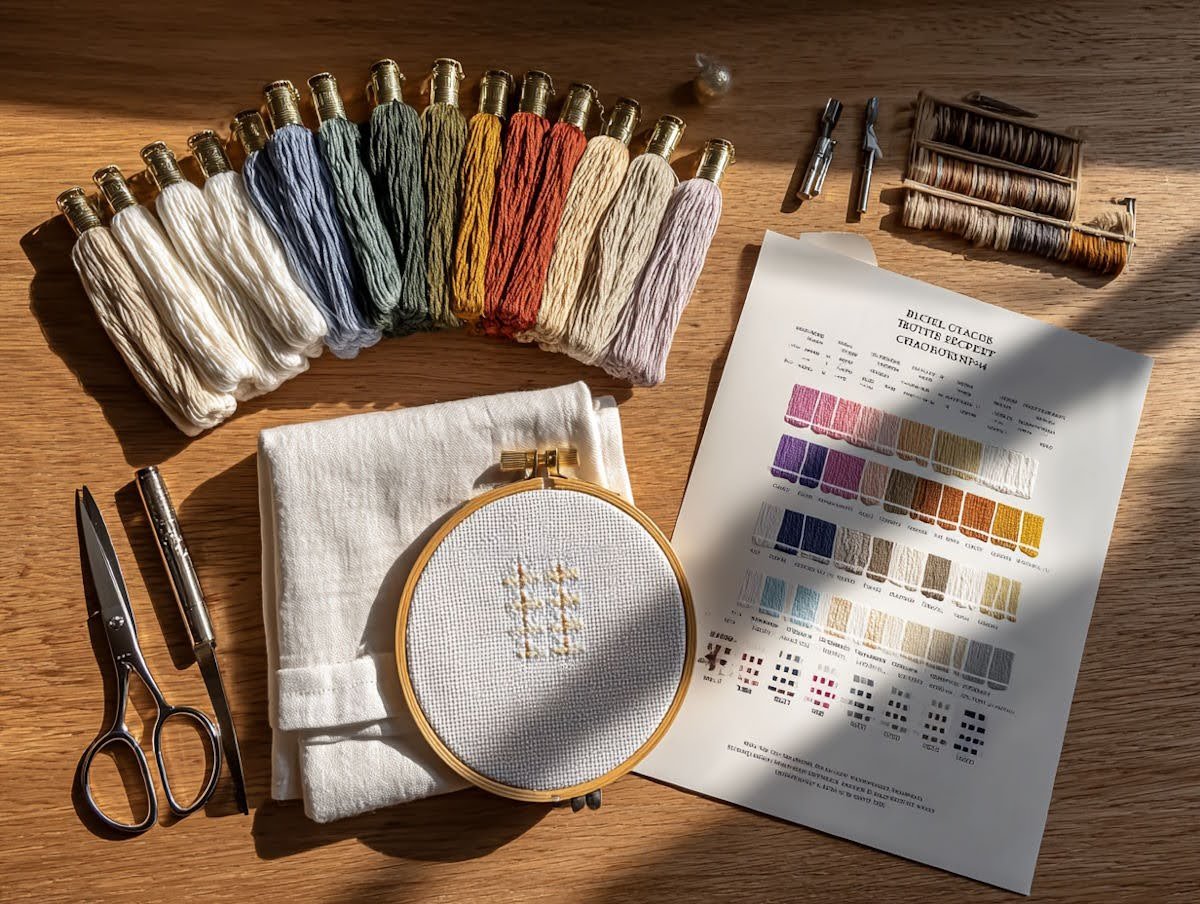
If you stitch with Bucilla® kits but organize your stash in DMC®—or you want to substitute DMC for a Bucilla color—having a reliable conversion chart saves time and prevents guesswork. This guide explains the context behind cross-brand conversions, how to read the downloadable Bucilla → DMC Threads Conversion Chart (PDF), and how to make confident color decisions in real-world stitching.
Our chart displays hex color codes in brackets after each DMC color name to give you a quick visual cue and to help with digital planning or design-tool workflows.
Why conversions exist—and what “closest match” means
Bucilla and DMC build their palettes using different dye formulas and finishing processes. Conversion charts don’t promise a perfect twin; they surface the nearest practical match. Expect tiny shifts in warmth or brightness, especially in neutrals, skin tones, and deep greens. That’s normal—and manageable when you verify by eye.
What’s inside the PDF
- Compact layout for speed. Each line reads Bucilla code → DMC code → DMC color name (HEX); then the second block mirrors the same three columns. This puts six columns per row on a page for fast scanning.
- Consistent headers and sectioning. The full chart covers the complete Bucilla range; headers keep you oriented at a glance.
- Multi-match notes. If a Bucilla shade sits between two DMC colors, both candidates appear on separate lines so you can choose after comparing.
How to use the chart (step by step)
- Find your Bucilla code. Check the floss card or legend in your kit.
- Look up the line in the PDF. Note the DMC code and the color name with the hex code in brackets.
- Visual check under your stitching light. Pull the DMC skein and compare a strand against the Bucilla strand. Small differences can disappear—or stand out—depending on lighting and fabric.
- Decide quickly with the hex swatch.
- Designing in software (Procreate, Photoshop, Stitch-fiddle, Pattern Keeper)? Enter the hex to preview blends, backstitch contrast, and shading before you stitch.
- Planning a gradient? Lay out the candidate DMCs side by side and confirm the whole run, not just one step.
- Mind strand count and coverage. DMC Mouliné is six-strand stranded cotton. Separate (“strip”) and recombine strands to match your chart (e.g., two strands on 14-count).
- Test a small patch. Stitch 10–20 crosses in a low-risk area. If the hue reads off at viewing distance, try the alternate DMC listed for that Bucilla number.
- Record the decision. Circle your final pick on the PDF or write it on the kit card to stay consistent across sessions.
Power tips from our designers
- Judge in context. Backstitch and metallics can change how a color reads; always assess with neighbors in place.
- Skin tones and neutrals: when in doubt, choose the option that looks slightly cooler at close range; warm room light often shifts it back toward neutral.
- Metallic or sheen areas: if your kit effect relies on shimmer, a plain-cotton swap may look flatter—consider a DMC effect thread for those accents and keep the rest in cotton.
- Fabric matters. Linen vs. aida, white vs. antique white, 14- vs. 18-count—all influence value and contrast. Confirm your choice on the actual fabric.
Understanding the hex codes in the PDF
The hex code beside each DMC color name is a visual approximation of that thread’s appearance, calibrated for on-screen planning and quick swatching. Use hex for:
- Digital mockups: preview palettes, backstitch visibility, and lettering contrast.
- Team handoffs: share color plans with collaborators who don’t have a physical floss card.
- Inventory and labeling: print small hex chips on project bags or floss bobbins for instant recognition.
Hex matches help you work faster, but they’re not a substitute for a real-thread comparison. Always trust what your eye sees in your stitching light.
When to deviate from the suggested DMC
- Legacy or discontinued numbers: if your kit uses a historic code that isn’t in the main run, use the nearest family and confirm by eye.
- Variegated or effect areas: variegation, metallics, or satin finishes won’t map 1:1—treat the chart as a starting point and audition alternatives.
- Artistic intent: if you want more pop (snow, stars, highlights), pick the slightly brighter DMC; for vintage or muted looks, nudge one step duller.
FAQ
Will the conversion give me a perfect match?
No chart can guarantee that. It points you to the closest DMC, then you verify on fabric in your lighting.
Why do some Bucilla numbers list two DMC options?
Because both candidates sit very close. Test both quickly; choose the one that looks right at viewing distance.
Can I go from DMC back to Bucilla using this chart?
Yes—just reverse the lookup—but treat it as guidance. Confirm on fabric before committing.
Do the hex codes replace a physical color card?
They’re a fast planning tool. For high-precision projects (portraits, skin tones), a real-thread color card plus a live comparison is still the gold standard.