
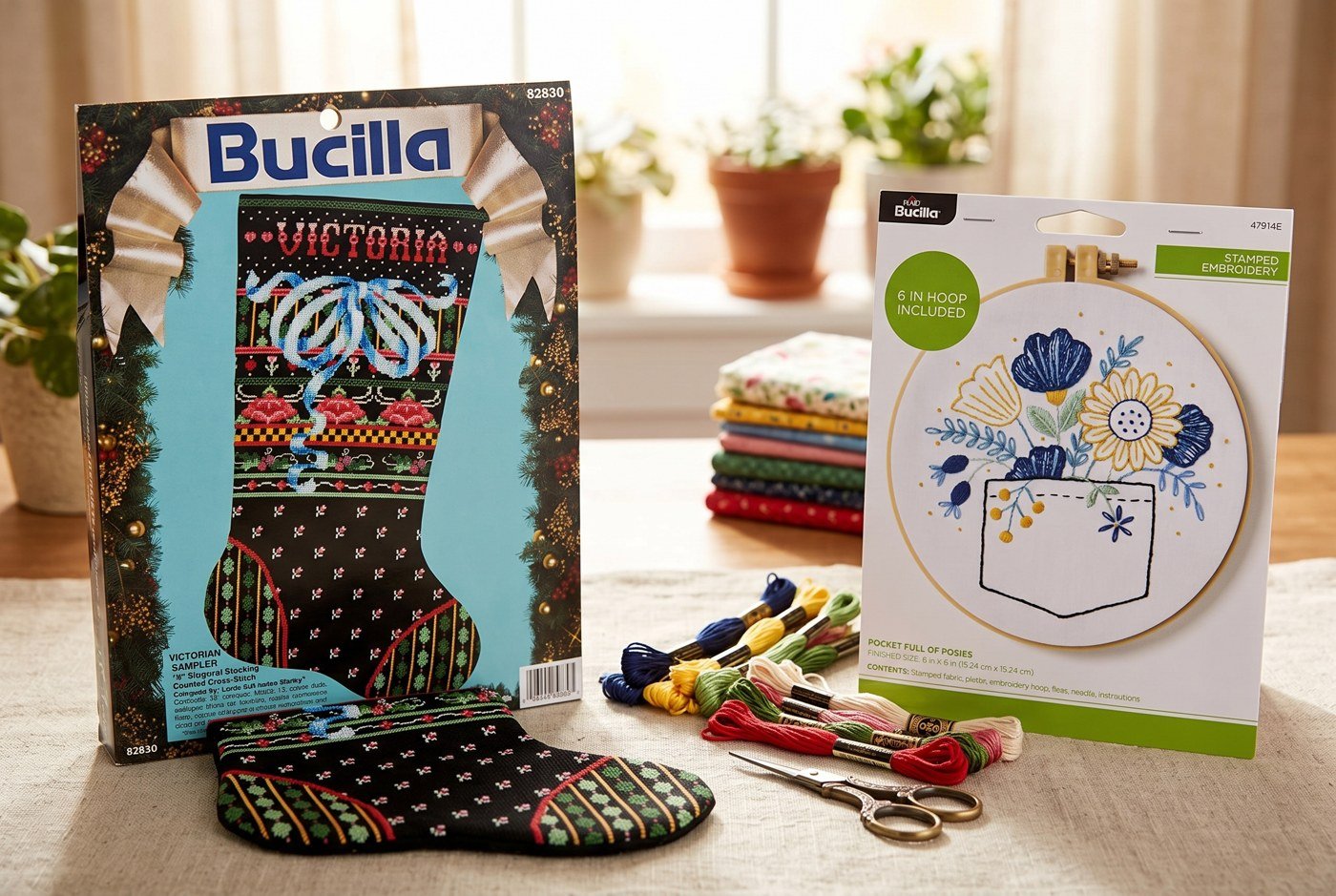
You see “stamped” and “counted” on Bucilla cross-stitch kits and you want to know which to pick. Here’s the answer in one paragraph, then the detail.
Counted cross stitch = you read a chart (a grid of symbols and colors) and stitch onto plain Aida cloth, counting squares from a starting point. Stamped cross stitch = the design is pre-printed in washable ink directly onto the fabric, and you cover each printed mark with a cross. Stamped is easier for beginners. Counted is the heirloom-grade choice for stitchers who want chart-precision finish. Bucilla makes both, plus a third related technique — stamped embroidery, where the design is printed but you stitch freehand embroidery (not cross stitch) over the marks.
This article unpacks the three, names which Bucilla kits use which technique, and gives you a 5-question decision tree at the end. By the time you finish reading you’ll know which kit to buy.
What “counted cross stitch” actually means
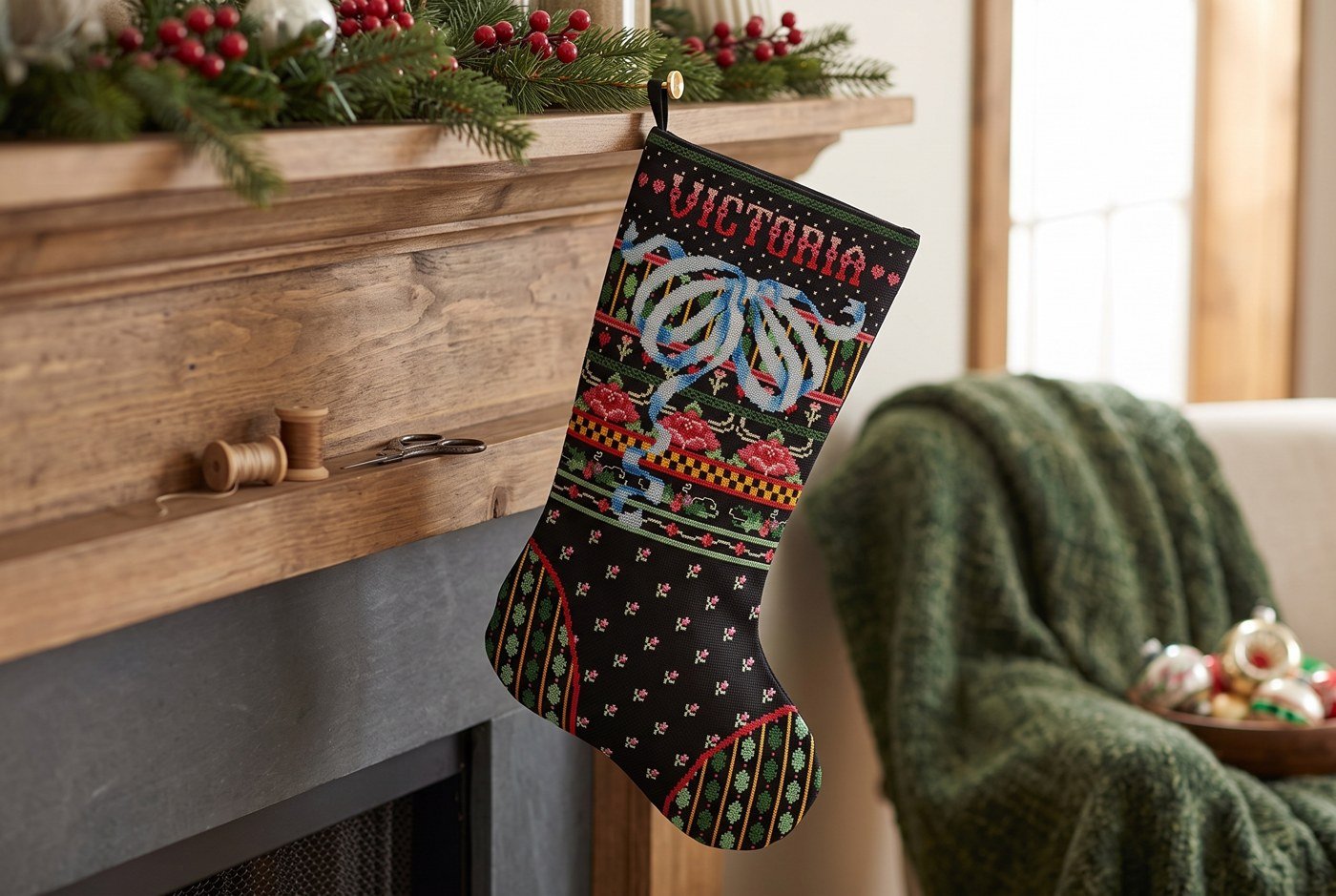
The fabric is Aida cloth — a stiff, evenly-woven fabric with a visible grid of holes between the threads. Bucilla counted kits typically ship with 14-count Aida (14 stitches per inch); some smaller pieces use 16- or 18-count for finer detail.
The pattern is a chart: a grid where each square represents one cross stitch, marked with a symbol indicating which floss color to use. The chart usually has a row of color keys down one side. You pick a starting point (often the center of the chart, marked with arrows), find the corresponding center of the Aida cloth, and stitch outward — counting squares to know exactly where each stitch goes.
The finished look is sharp, graphic, and detailed. Counted cross stitch produces the most precise renderings — fine portraits, complex samplers, intricate religious imagery — because every stitch is placed exactly where the chart says.
Bucilla counted cross stitch examples:
- Victorian Sampler (82830) — Christmas stocking on 14-count Aida, finishes at 19″ diagonally
- Amazing Grace (42563) — religious sampler, 20″ × 12″ finished, Made in USA
- Jesus Christ at 11×14 (41644) — portrait adapted from Heinrich Hofmann, 14-count wheat straw Aida, 11″ × 14″ finished, trilingual instructions
- Princess Pink Birth Record (45328) — counted cross stitch birth record (retired)
- My 1st Stitch Heart (45457) — small counted mini for beginners
- Flowers of the Month Bookmark (45571) — the smallest counted CS project in the line
What “stamped cross stitch” actually means
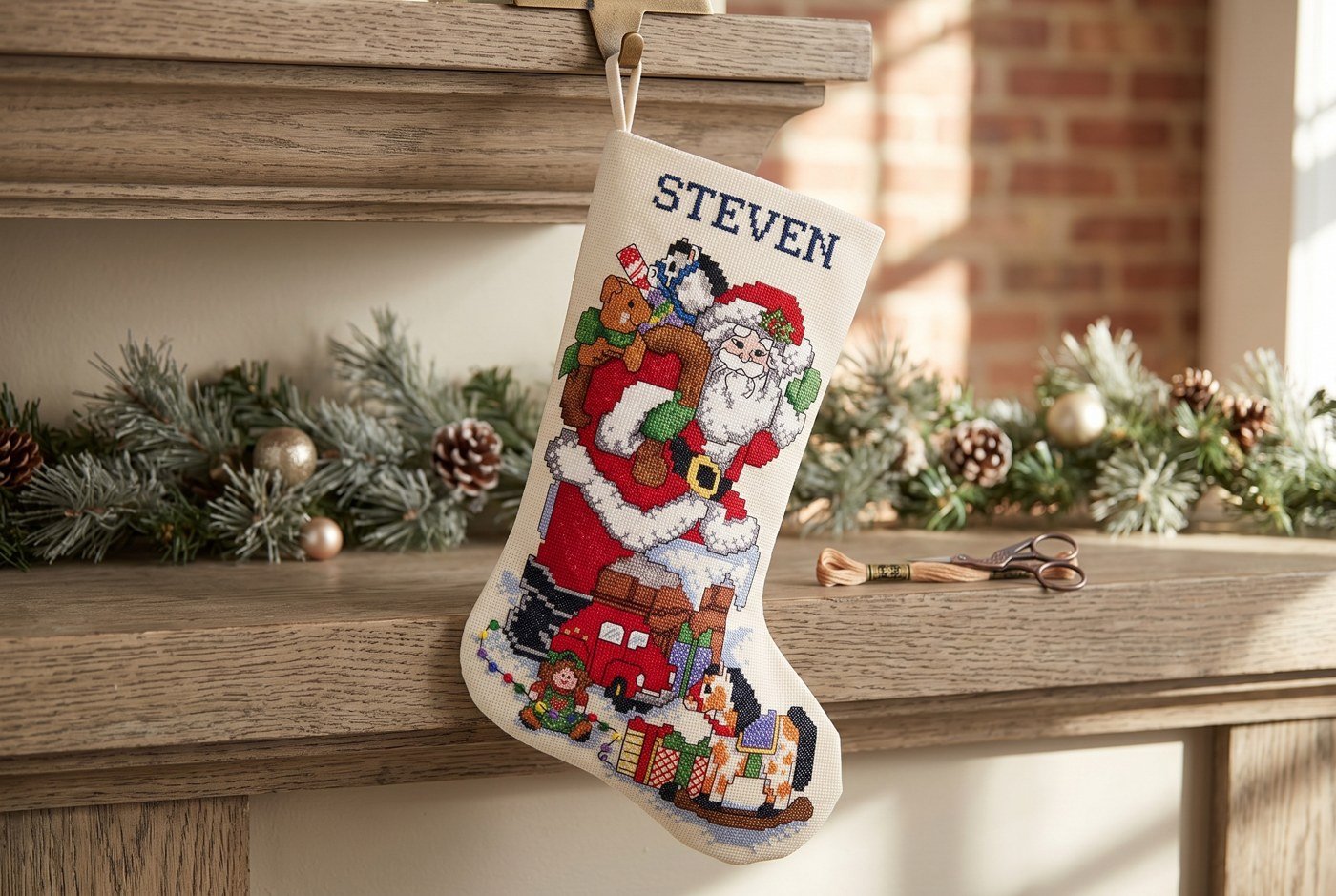
The fabric is a softer woven fabric (typically a cotton-poly blend) with the design printed directly onto it in washable blue ink. You cover each printed cross mark with a stitched cross — same X-shaped stitch as counted cross stitch, but no chart reading required. The printed marks fade as you stitch over them; once finished, the marks disappear under the floss.
The finished look is slightly softer than counted CS — the cross-stitch grid is less mathematically precise because the fabric weave isn’t as rigid as Aida. For larger pieces (crib covers, baby quilts, table runners) this is an advantage; for fine detail (portraits) counted is sharper.
Bucilla stamped cross stitch examples:
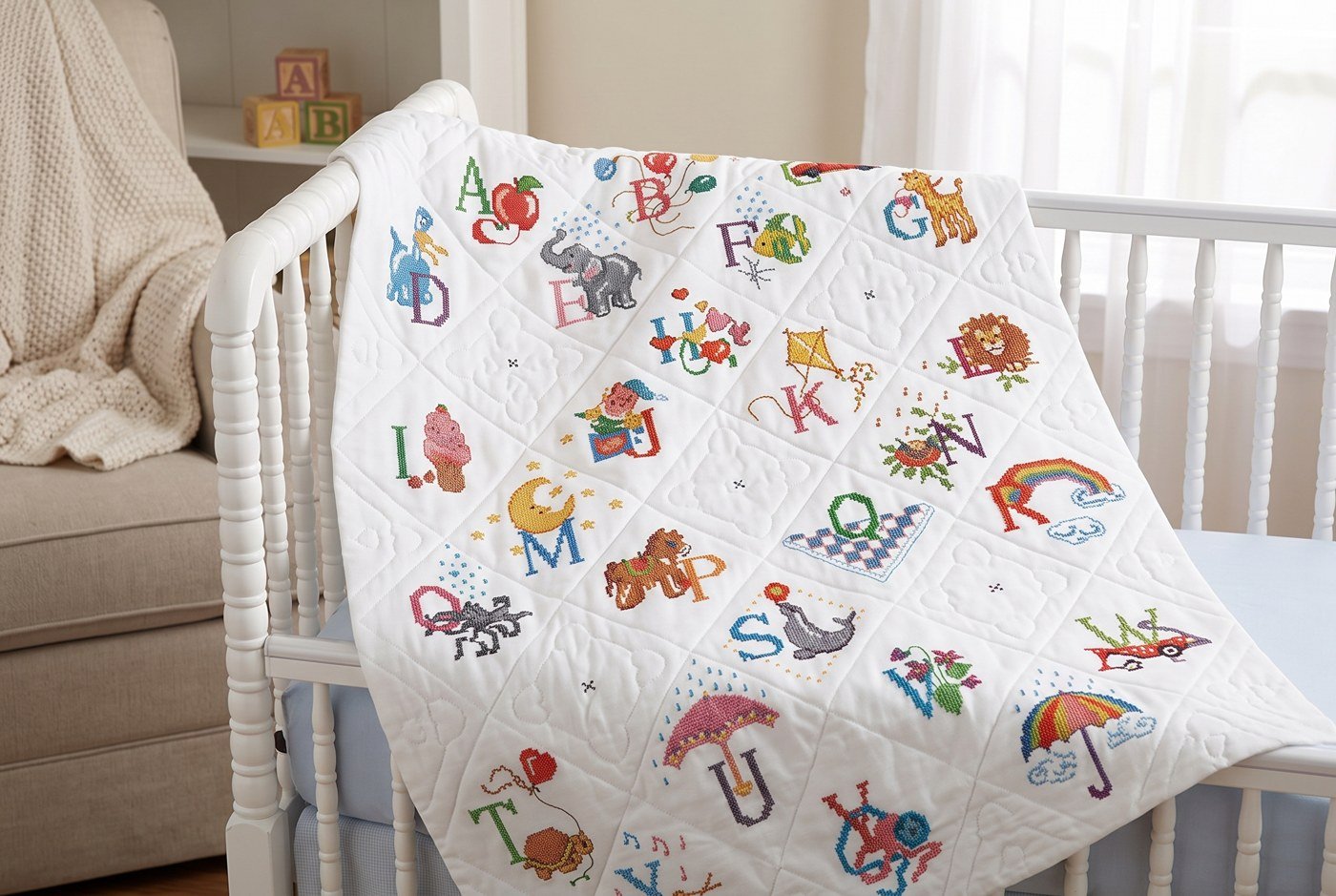
- Alphabet Dreams (43241) — baby quilt, 34″ × 43″, trilingual instructions, with DMC floss requirement specs for bright or pastel palette
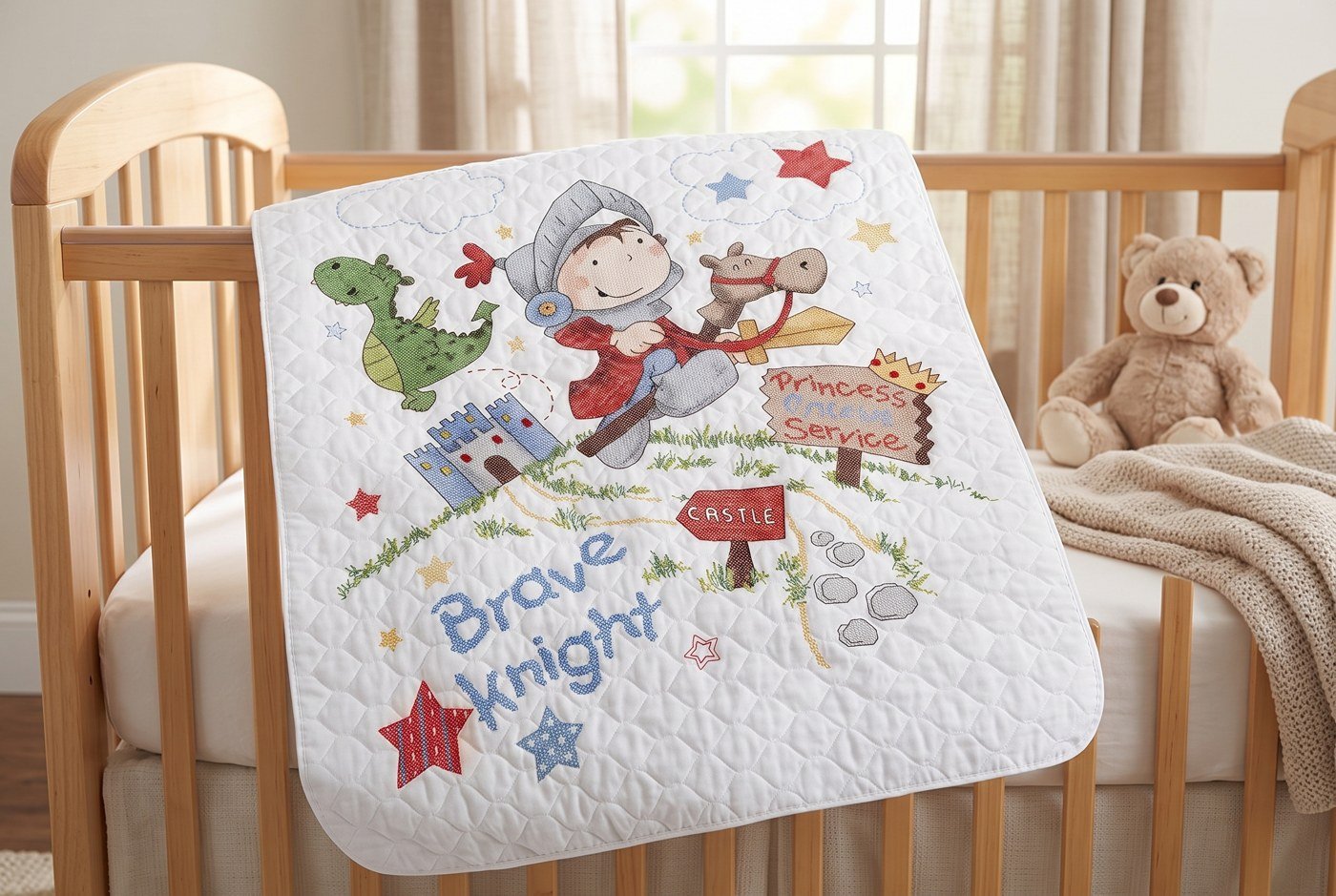
- Brave Knight (45399) — crib cover, 34″ × 43″, stamped on 30% cotton / 70% polyester
- On the Farm (45567) — crib cover, farm animals
- Lullaby Safari (678805) — crib cover, safari theme
- Down the Chimney (83053) — Christmas stocking, stamped on fabric, no chart reading
Stamped embroidery (a third, separate technique)
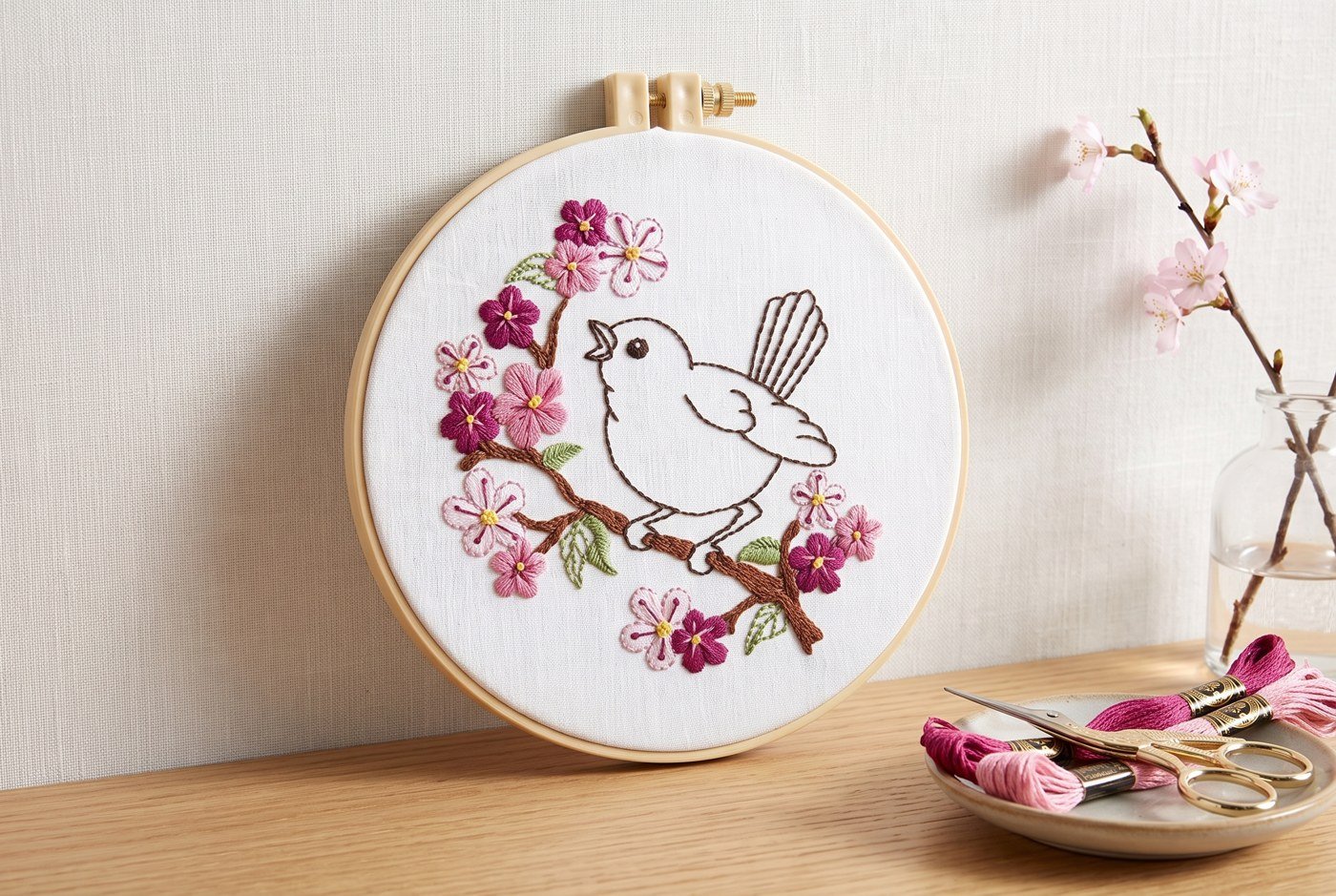
The third technique on Bucilla’s catalog is stamped embroidery. The fabric is printed with a design (same as stamped cross stitch) but you stitch freehand embroidery stitches over the marks — running stitch, back stitch, stem stitch, satin stitch, French knots — not cross stitches.
This is important: a “stamped” kit isn’t automatically cross stitch. Read the kit description.
Bucilla stamped embroidery examples:
- Pocket Full of Posies (47914E) — floral panel
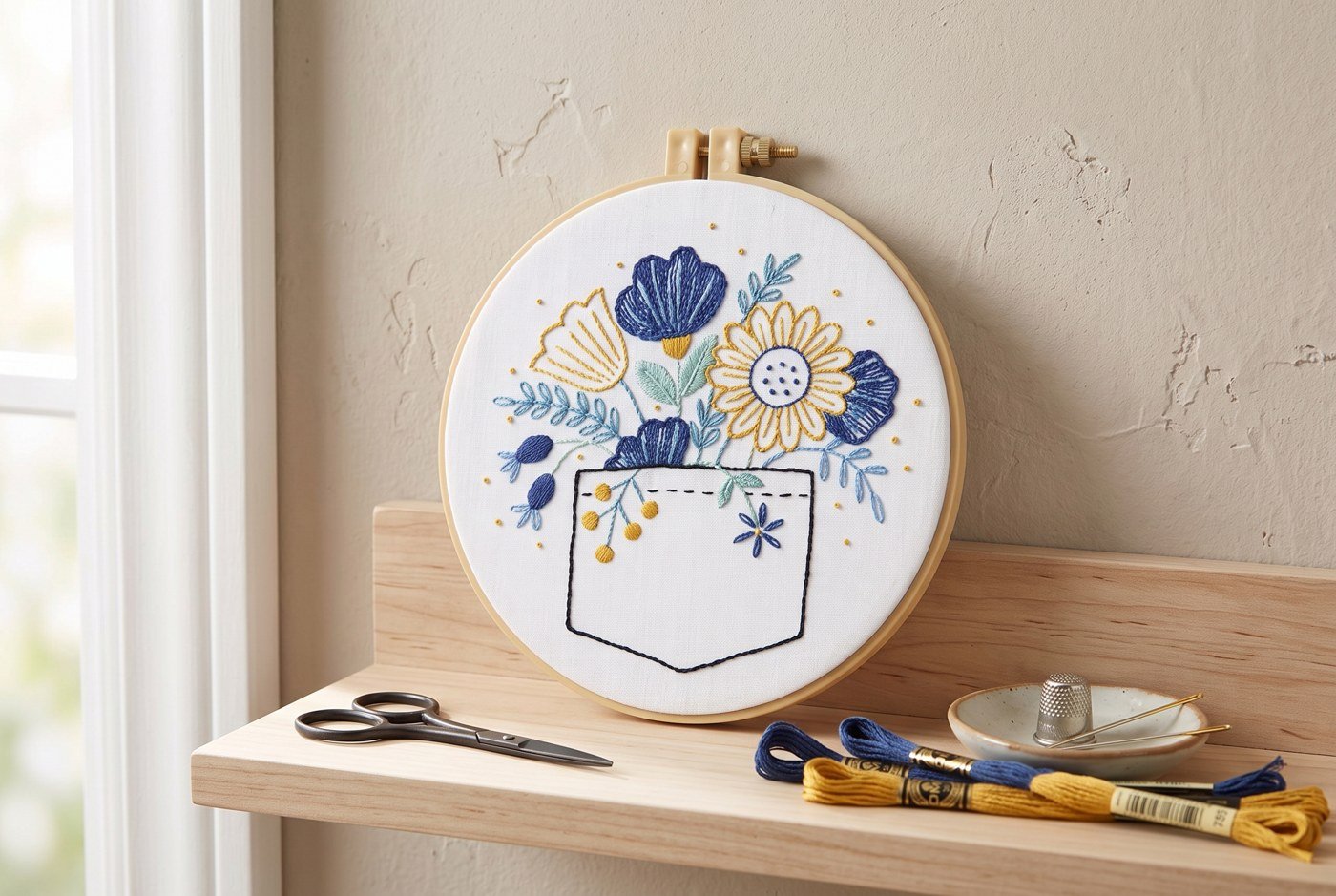
- Cherry Blossom Birdie (47917E) — botanical
- Autumn Foliage (49535E)
- Golden Sunflower (49547E)
If you specifically want cross stitch, skip the stamped embroidery kits.
Skill comparison
| Factor | Counted CS | Stamped CS | Stamped embroidery |
|---|---|---|---|
| Chart reading required | Yes | No | No |
| Counting required | Yes | No | No |
| Stitches used | Cross stitch + backstitch | Cross stitch | Variety (running, back, stem, satin, French knot) |
| Error recovery | Harder — miscounted squares cascade | Easier — printed mark shows where to stitch | Easiest — freehand allows adjustment |
| Time per square inch | Slowest | Medium | Fastest |
| Skill level (Bucilla line) | Intermediate | Beginner-friendly | Beginner-friendly |
| Finish precision | Sharpest | Softer | Most artistic / variable |
| Best for | Heirloom portraits, samplers, religious art | Crib covers, baby quilts, larger decor | Wall art, pillow fronts, smaller decorative pieces |
What’s in the box for each
Counted CS kit (Bucilla): Aida cloth (count varies — 14-count is most common), charted pattern, cotton embroidery floss color-separated, floss separator, needle, instructions. Some kits (like Amazing Grace 42563) also include a metallic filament for highlight stitches.
Stamped CS kit (Bucilla): pre-printed fabric (a cotton-poly blend in most kits), cotton embroidery floss, needle, chart for any small unstamped areas (borders, etc.), trilingual instructions in many kits.
Stamped embroidery kit (Bucilla): pre-printed fabric, cotton embroidery floss, needle, illustrated instructions showing which embroidery stitches to use.
Note: Bucilla’s felt-applique line (stockings, ornaments, wreaths, advent calendars) is a completely different category — felt instead of fabric, applique technique instead of cross-stitch. If you’re trying to pick between felt-applique and a cross-stitch kit, the stocking kits guide covers that decision specifically.
Which Bucilla kits use which technique — quick reference
Counted cross stitch (chart-reading required):
- All Bucilla SKUs labeled “Counted Cross Stitch Kit”
- Includes the religious / portrait line (41644 Jesus Christ, 42563 Amazing Grace, B009VFV63K Lord’s Prayer)
- Most birth records (45328, 45725)
- The smaller mini-kits and bookmarks (45571 Bookmark, 45457 Heart)
- Two of the Christmas stockings (82830 Victorian Sampler, 83035 Santa Collage)
Stamped cross stitch (no chart-reading):
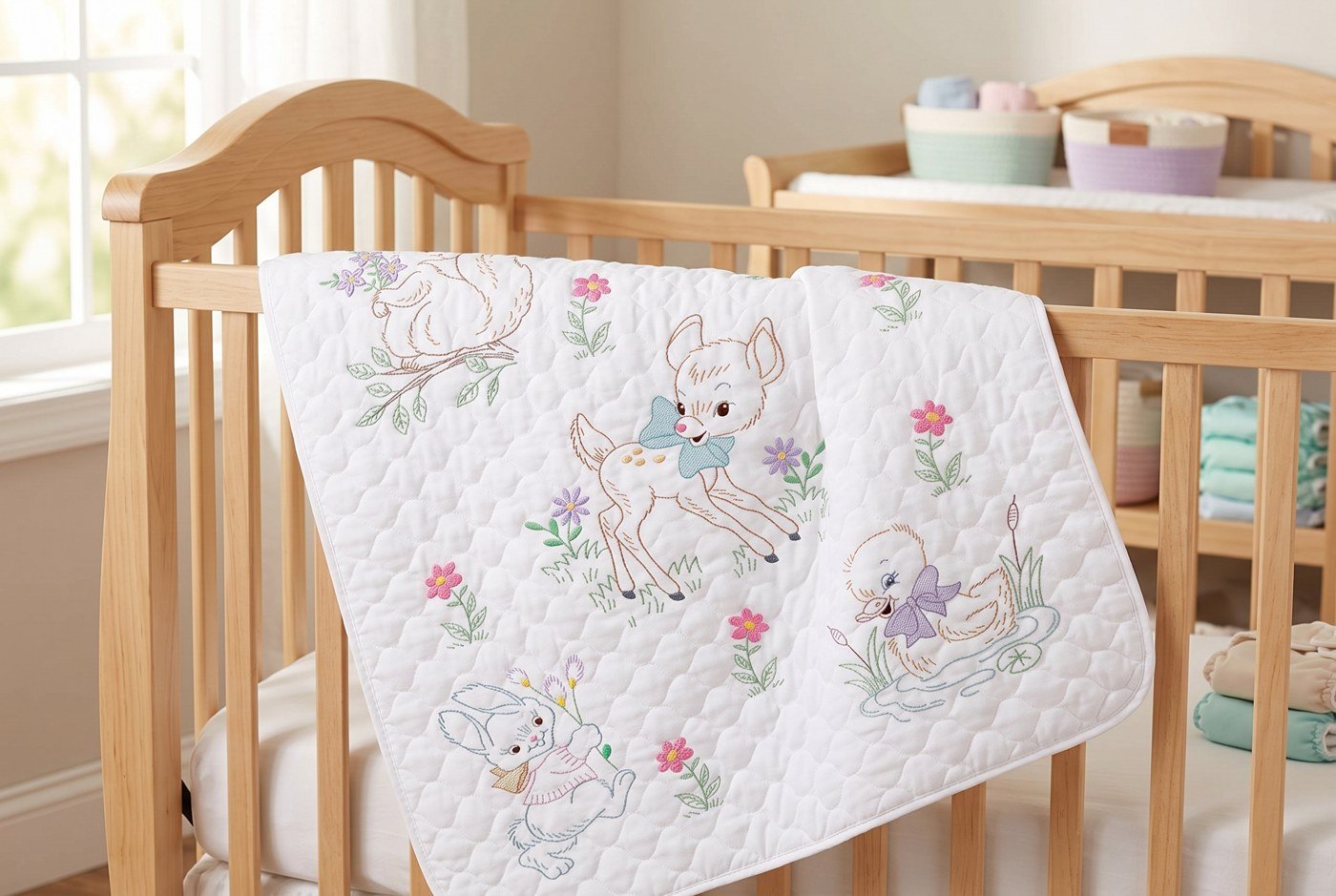
- Most baby crib covers (45399, 45567, 678805)
- The Alphabet Dreams baby quilt (43241)
- One Christmas stocking (83053 Down the Chimney)
- Some table runners and home decor (82652 Holiday Tree Table Runner, 83321 Angels of Christmas)
Stamped embroidery (freehand embroidery, no cross stitch):
- The 47900-series floral panels (47914E Posies, 47917E Cherry Blossom Birdie)
- Most 49500-series stamped embroidery kits (49535E Autumn Foliage, 49534E Potted Beauty, 49547E Golden Sunflower)
- The Springtime Baby Animals panel (49472E)
The 5-question decision tree
Answer these in order. Stop at the first definitive answer.
1. Have you ever read a cross-stitch chart before?
- No, and I don’t want to learn right now. → Stamped CS or stamped embroidery.
- Yes, comfortable. → Counted CS is open to you; continue.
- No, but I want to learn. → Start with a small counted kit (45571 Bookmark, 45457 Heart, 47816E Unicorn) before committing to a big one.
2. Are you stitching for yourself or as a gift?
- Self. → Pick whichever technique you’ll enjoy. Both produce beautiful finished pieces.
- Gift, with a specific deadline. → Stamped is faster. Counted takes 1.5–2× as long per equivalent finished area.
3. What’s the finished piece — a small decorative item or a large covered surface?
- Small, fine detail (portrait, sampler). → Counted. The precision matters.
- Large covered surface (crib cover, quilt, table runner). → Stamped. The softer finish suits the format and the time-per-square-inch matters when the project is big.
4. Have you done embroidery (not cross stitch) before — running stitch, satin stitch, French knots?
- Yes. → Stamped embroidery is a real option; you’ll enjoy the variety of stitches.
- No. → Skip stamped embroidery for now. Stamped CS is simpler if you want a stamped project.
5. Is the project for a child to help with?
- Yes, under 10. → Stamped CS. No counting, immediate visible progress.
- Yes, 10+ with patience. → Either, but small counted (My 1st Stitch series — 45457, 46309E, 47816E) is a real option.
- Adult only. → Any.
The finished look — side by side
The same design in counted CS and in stamped CS reads slightly different finished.
Counted CS: every cross sits exactly where the chart placed it. The grid is mathematically regular. Outlines (added in backstitch as the final step) are crisp. Portraits look like portraits — the kind of finish that holds up to close inspection in a framed wall piece.
Stamped CS: the crosses follow the printed marks, which were printed onto a softer fabric than Aida. The grid is slightly looser. The finish reads as warm, almost like a quilt block. This is the right finish for a baby blanket — soft, tactile, less “clinical” — but it’s not the right finish for a framed Christ portrait.
Both are beautiful. They’re different, not ranked.
FAQ
Can you mix stamped and counted on one project? No. The fabrics are different, and the techniques are too distinct to combine within a single piece.
Do stamped kits include a chart? Sometimes — for borders or small unstamped areas. The main design is on the fabric. You don’t need to read a chart for the bulk of the work.
Will the printed marks show through finished stitches? No. The cross stitches cover the printed marks completely. The blue ink is washable and any tiny visible traces wash out at the final cleaning pass.
Can I wash a finished piece? Both: spot-clean for everyday. For periodic washing, gentle cycle, cold water, mild detergent, air dry. Never tumble dry — embroidery puckers.
Which is better for kids? Stamped CS. No counting required, immediate visible progress, harder to “fail.” For an older / patient kid, the small My 1st Stitch counted kits (45457 Heart, 47816E Unicorn) work.
If I run out of floss, can I substitute? Yes. The Bucilla-to-DMC conversion chart gives you the closest DMC equivalent for every Bucilla color code.
Which technique is “real” cross stitch? Both. Counted is older and more traditional in the modern cross-stitch community; stamped has been part of the craft since at least the mid-20th century. Neither is “lesser.” They serve different buyers.
Why is the Bucilla stamped CS fabric blend always polyester? The blend (typically 30% cotton / 70% polyester for crib covers, 50/50 for baby quilts) is chosen for durability under washing — pure cotton stamped fabric distorts more than the blend. The stamped ink is also more reliably washable on a blend.
Recommended starter kits
Best for a counted CS beginner:
- Flowers of the Month Bookmark (45571) — smallest project in the line, finishes in under 5 hours, ideal “first counted CS”
- My 1st Stitch Heart (45457) — small mini, designed for new stitchers
Best for a stamped CS beginner:
- Brave Knight Crib Cover (45399) — large but no chart reading, trilingual instructions
- Down the Chimney Stocking (83053) — for the buyer who wants a stocking without committing to counted
Best for “try both before committing”:
- My 1st Stitch Unicorn (47816E) — small counted CS to test the technique
- Springtime Baby Animals (49472E) — stamped embroidery (the third technique) to test a different stitching family
What to choose next
- Counted cross stitch kits — the full counted line
- Stamped cross stitch and home decor — crib covers, table runners, quilts
- Stamped embroidery panels — wall art and pillow-front projects
For technique-specific deep dives, see How Long Does a Bucilla Felt Stocking Take (the time question applies similarly to cross-stitch — counted takes longer) and the DMC conversion chart for thread substitution.
The technique you pick should match the project you want to finish, not what sounds more impressive on a craft-blog. Both stamped and counted produce pieces a family keeps. Pick the one you’ll actually complete.